
Autocross Rules
The mission and purpose of the Chesapeake Porsche Club of America Autocross Program is to provide a structured environment in which to promote the teaching and improvement of driving skills in a safe and controlled environment. The Autocross Program is designed to teach each participant advanced car control technique, so that the participants can improve their driving abilities, better understand the handling and dynamics of their vehicle in a real world environment, and become better, safer drivers.
Conduct
Any conduct at an Autocross event considered by Chesapeake Region PCA to be either unsafe or inconsistent with the spirit or purpose of the Chesapeake Region PCA Autocross Program will not be permitted. The Chesapeake Region PCA Officers, Board of Directors, and the Autocross Co-chairs reserve the right to immediately suspend driving privileges or refuse entry to any participant that cannot abide by the rules whether stated herein or otherwise implied.
Any driver that cannot adhere to the rules will be disqualified and asked to leave.
Any driver disqualified more than twice will be banned from participating for the remaining duration of the series.
The rules, guidelines and procedures are intended to promote safe and fair competition within the ideals of good sportsmanship and are based upon PCA Parade 2025 rules. The rules are subject to revision at any time at the discretion of the Co-chairs. Revisions, if any, will be discussed at the drivers meeting.
GOOD LUCK and BE SAFE.
Scoring and Awards
Points will be awarded to all PCA members. Points shall be awarded as follows:
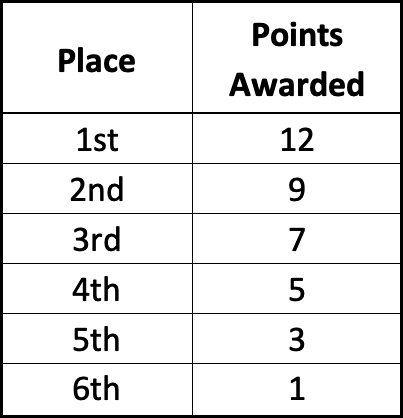
- All PCA participants will receive at least 1 point for entrance into a Chesapeake PCA autocross event.
- Ties will not be broken. In the event of a tie, the drivers will be awarded equal points.
- Points will be awarded for the top finishers in each class up to five places deep within a class minus one car (i.e. two cars in a three car class will trophy) or at the discretion of the Co-chairs or Autocross Committee.
- Award rules:
- Autocross Series Class Awards (trophies) shall be awarded to Chesapeake members at the end of the season by class as follows:
- 1-2 drivers 1 trophy; 3-5 drivers 2 trophies; 6 or more drivers 3 trophies
- Awards are given to the points leaders.
- Awards are given to drivers who participate in four or more events.
- Autocross Series Class Awards (trophies) shall be awarded to Chesapeake members at the end of the season by class as follows:
- If you are not a Chesapeake member, you can join as a dual member or join PCA. Information on membership can be found here.
Car Classification
Competitors are responsible for the policing of and adherence to the car classification rules. The Autocross and Tech Chair shall handle all Classification and Modification protests. All decisions are final.
Class Bumping
One participant makes a class. There is no class bumping.
So is your Porsche Showroom Stock, Production, Improved or Modified?
Compare your Porsche against the Category Allowances chart below:
- If your Porsche is listed in a Showroom Stock class but fails to conform to each item in the Stock column, then it bumps to the corresponding Production class.
- If your Porsche fails to conform to each item in the Production column, then it bumps to the Improved class.
- If your Porsche fails to conform to each item in the Production column, then it bumps to the Improved/Modified class.
Class Summary Descriptions
There are four categories of classes for Porsche automobiles – Showroom Stock (S), Production (P), Improved (I) and Modified (M). Each category is then broken down into classes based on the specific automobile for Showroom Stock and Production classes and based on number of cylinders and displacement for Improved and Modified classes. Based on historical attendance numbers, there is currently one class for Improved/Modified class.
Showroom Stock (S) – As the name implies, the Showroom Stock (S) Category is for automobiles nearly identical to those as they were available from the dealer. Very few changes are allowed and tires must have a tread wear rating of 140 or greater (no R Compound tires). Aftermarket wheels are allowed, but they must have the same width and diameter as available from the factory. Neither supplemental driver restraints nor aftermarket seats are allowed.
Production (P) – The Production (P) category is for automobiles that have limited performance modifications. Aftermarket seats, supplemental driver restraints, roll bars, and steering wheels are allowed, but the rest of the interior must remain intact. Aftermarket coil springs/torsion bars are allowed, but they must be the same type and mount in the same manner as original. DOT approved R Compound tires are allowed.
Improved (I) – The Improved (I) category is for automobiles with more substantial performance-affecting changes from standard (stock) specification. These modifications have defined limits.
Modified (M) – The Modified (M) category contains automobiles that have performance-affecting modifications outside of the limits of the Improved category and for race automobiles (factory-built or otherwise).
Guest (G) – The Guest category is for non-Porsche automobiles.
If you are unsure of your vehicle class, please check with the autocross staff for guidance.
Protests
All classification and modification protests must be presented in writing to the Autocross Chair within 20 minutes of the last run. The decision of the Chair is final. The decision need not be made at the event.
How to Determine Your Car Class
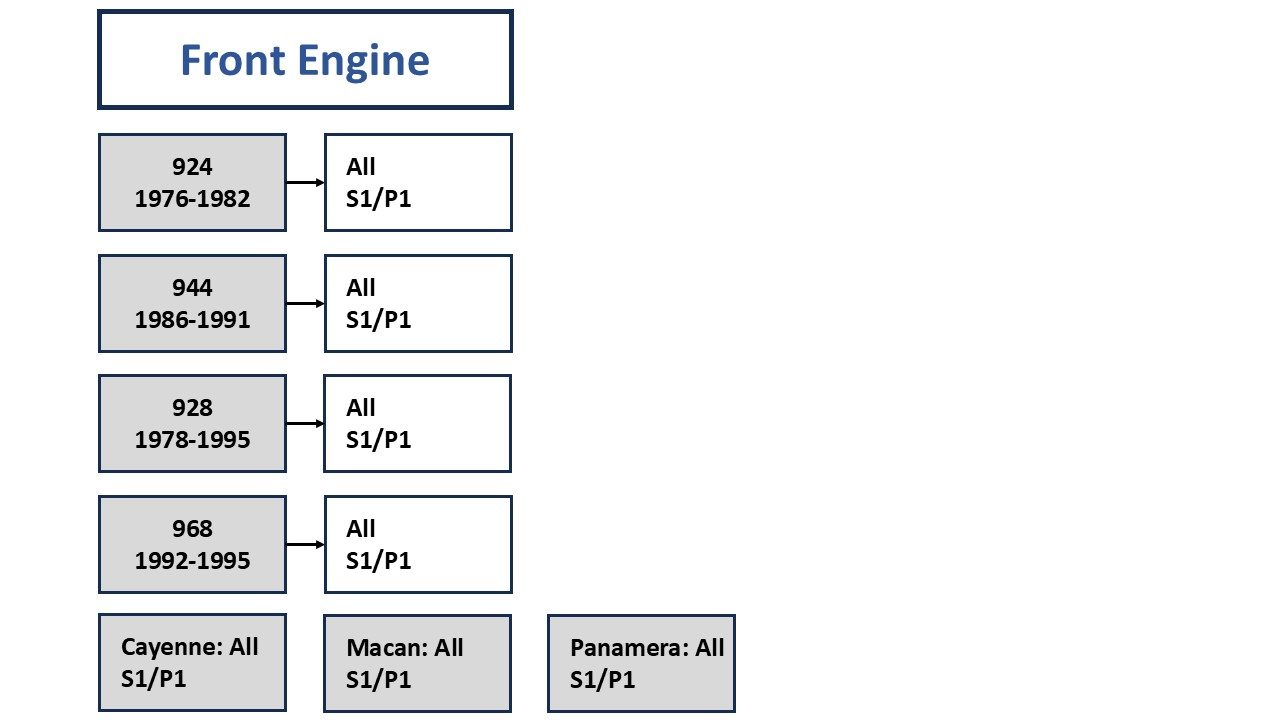
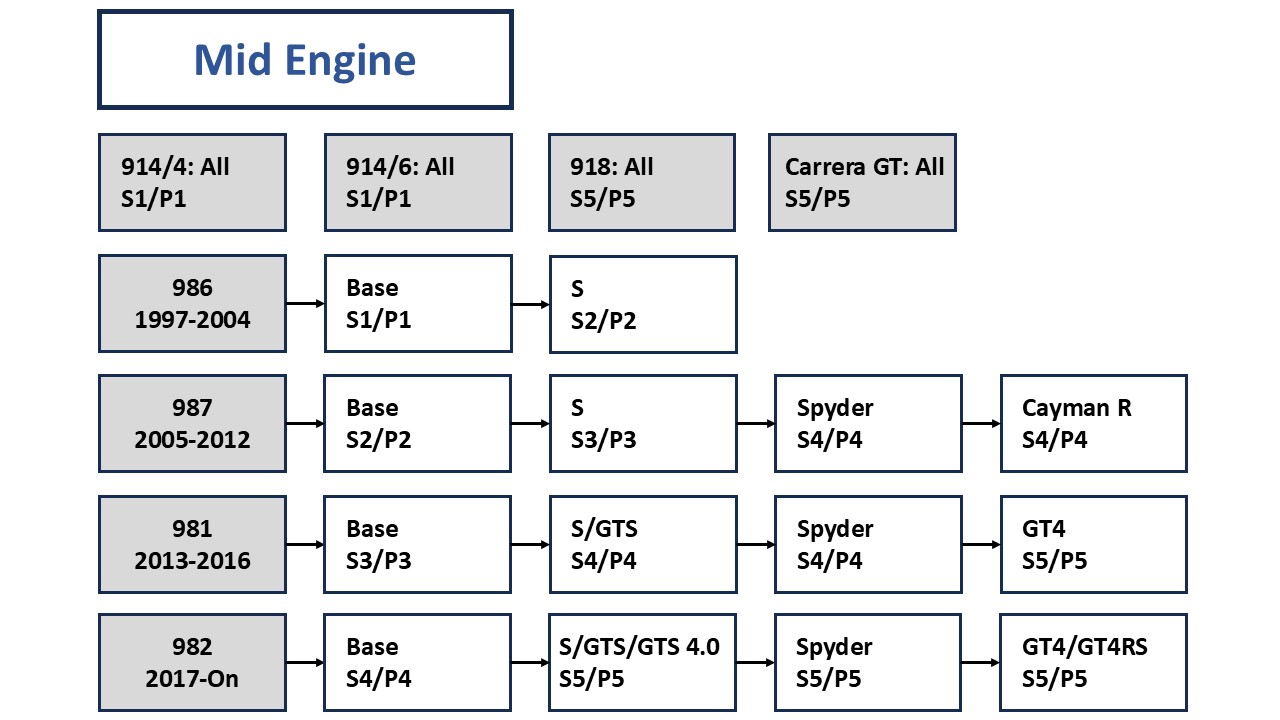
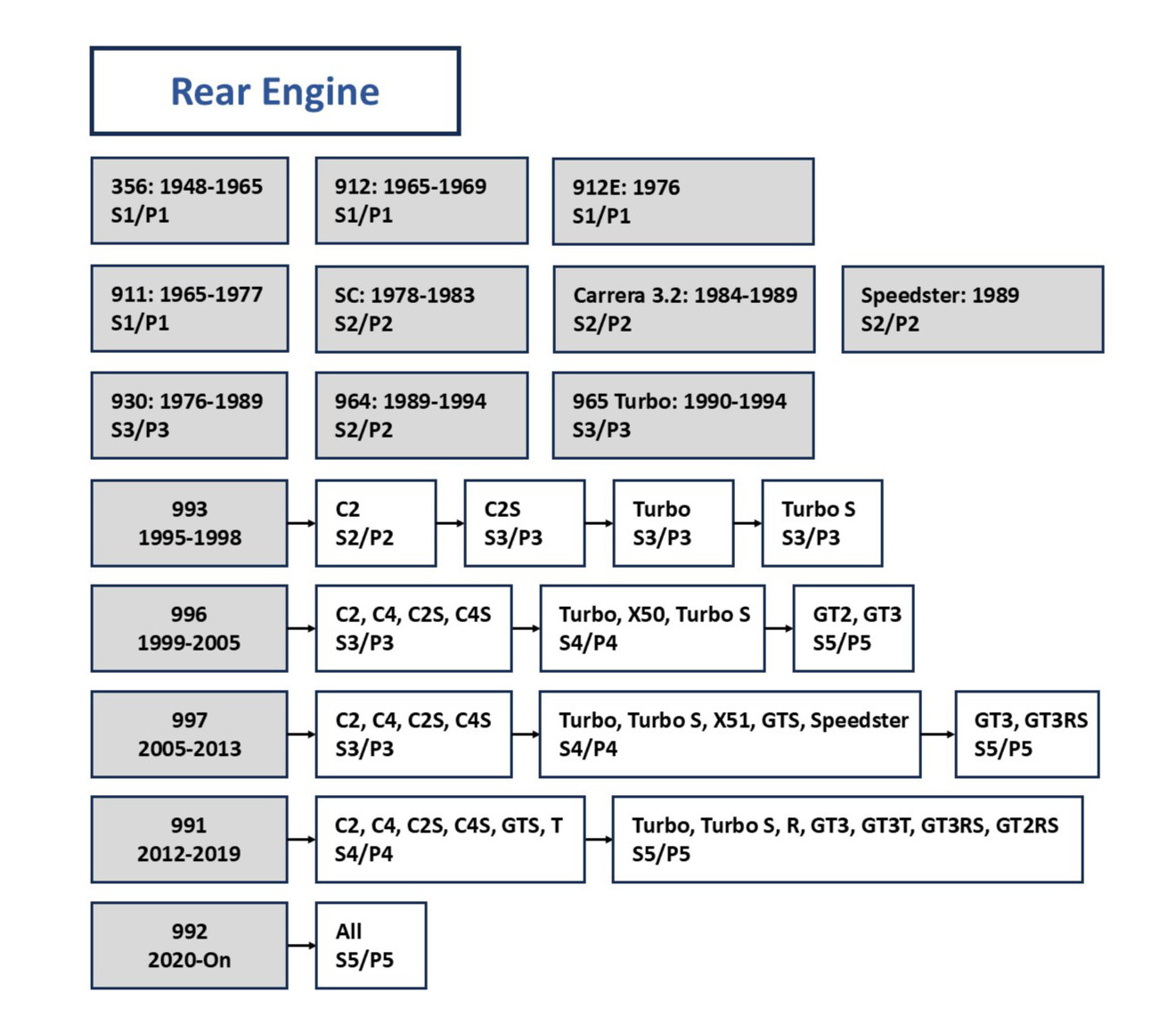
Find your Porsche model and generation in these charts to determine your Showroom Stock or Production class. Only one class exists in Improved and Modified classes. Click chart below to enlarge image.
Front Engine Porsches
Mid Engine Porsches
Rear Engine Porsches
EV Porsches
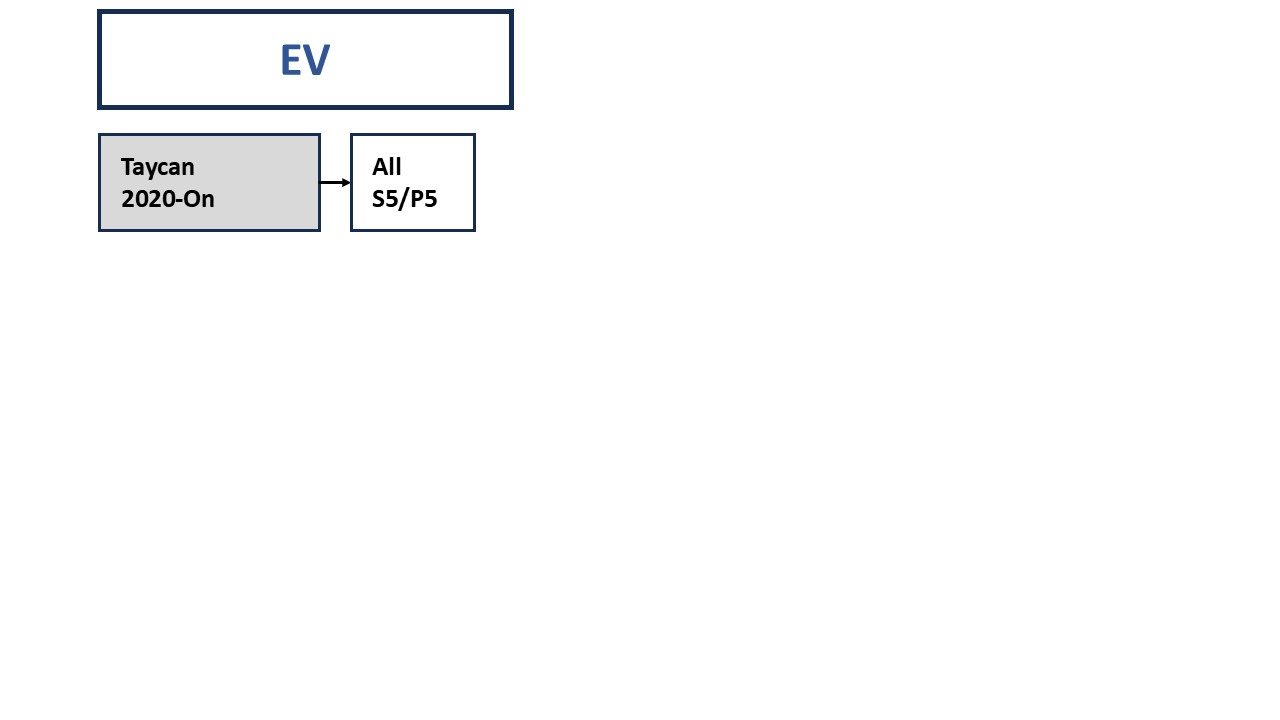
PCA Chesapeake Autocross Classes
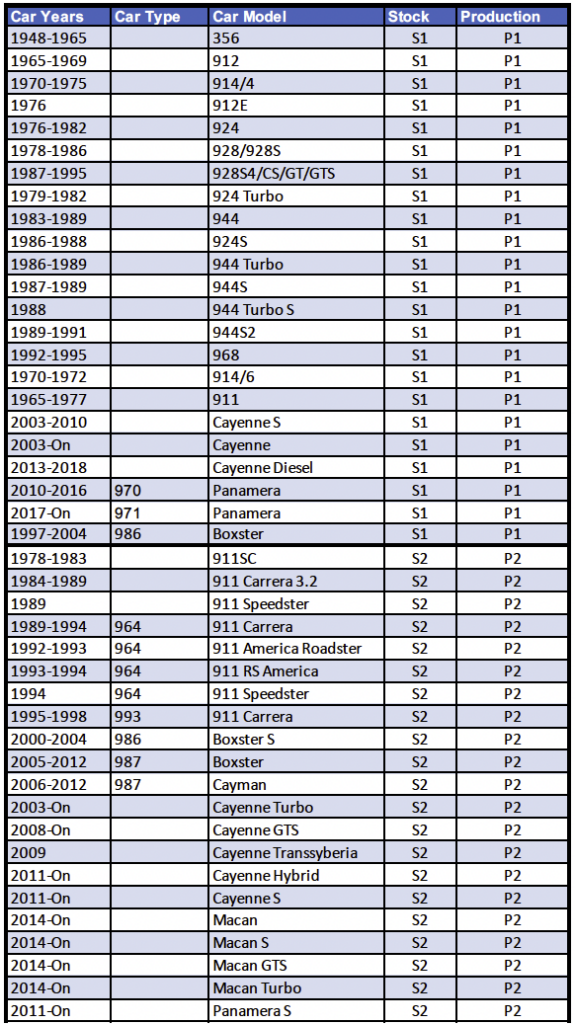
Category Allowances
The Chesapeake and Potomac PCA autocross rules derive from the 2025 PCA Parade Competition Rules with modifications to suit our local events. Allowances are divided up into five categories: Free, Showroom Stock, Production, Improved, and Modified. (PDF: 2026 CHS-POT AX Rules v1.pdf)
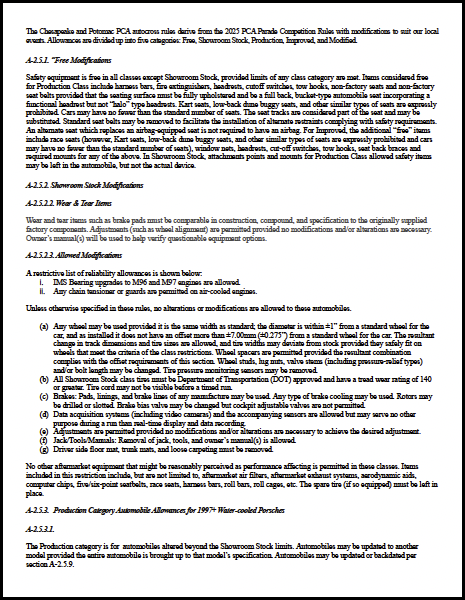
Safety
General – The addition of safety equipment including but not limited to roll bars, roll cages, fire extinguisher (2.5 lb min. ABC or BC type) with metal bracket mounted to a metal surface and accessible from belted seating position, seat belts/safety harnesses, harness guide bars, steering wheels, aftermarket seat is permitted and recommended.
- Roll bars are recommended for cabriolets.
- No drugs or alcoholic beverages are permitted at the event.
- No Passengers are allowed.
- An adult must accompany children at all times.
- Dogs must be leashed, where permitted.
Helmets – All drivers and instructors must wear helmets. Helmets must be Snell 2015 approved or newer (M or SA rated). SA rating is recommended. DOT helmets are not permitted. A limited number of loaner helmets are available for the day. All drivers should invest in their own helmet.
Clothing – Long sleeve shirts and long pants are suggested. Acceptable fabrics are natural fibers (cotton, wool, silk.) Open toed shoes, sandals and bare feet are not permitted. Rubber soled shoes (sneakers, etc.) are recommended. Driving shoes and gloves as well as fire resistant clothing is recommended but not required.
Seat Belts – All cars must have metal-to-metal seat belts, securely anchored. All drivers must wear belts.
Windows – The drivers side windows shall remain fully down during a run, passenger windows may be fully up or fully down.
Cleaning out your car, glove box and trunk
Loose objects inside the trunk, passenger compartment and glove box must be removed from the car. Loose objects include cell phones, change, paper, garbage, cups, floor mats, etc. In other words everything must be removed from your car.
The spare tire need not be removed if it is securely fastened. The battery must be securely fastened as well.
Pit & Paddock Area – All cars are to be parked within the designated pit & paddock area, except for vehicles used by timing, safety, and the Autocross Committee. There is no speeding allowed in the pit & paddock area. Any driver speeding in the pit or paddock area may be disqualified from the event at the discretion of the Co-chairs or Committee. Please no speeding in the general vicinity of the event.
Tire Warming – Tire warming is not permitted.
Inclement Weather – An event may be postponed, delayed, or ”called” due to inclement weather based upon the judgment of the Chesapeake PCA Officers, Board, Autocross Co-Chairs, or Committee. Once an event is underway and the event is halted for the day, if all cars have competed at least one run, placing will be awarded on best time based upon completed run groups.
Events may be cancelled prior to the commencement of an event due to inclement weather. If you are in doubt of the status of an event, please check the Chesapeake PCA Facebook page for up-to-the-minute details.
Procedures
Entrants – A participant may only enter one (1) car per event with a maximum of two (2) drivers per car. Participants can only compete in one (1) car per event. Swapping or switching of cars or drivers is not permitted.
Instructors – The instructors for the day will be announced at the drivers meeting. If you require an instructor, please notify a grid worker. Timing will assign an instructor to you for your next run. Instructors are permitted as passengers only.
Ride-Along/Passengers – No passengers are allowed at any time (due to our insurance regulations) except for pre-approved instructors as passengers only or passengers riding along with instructors.
Work Assignments – Mandatory work assignments are allotted at registration to each driver. Work assignments include flagging, tech, and registration. If you are unsure of your work assignment, please ask. You must complete your work assignments to run. If you do not complete your work assignments you will be disqualified, your runs will not count, and no points will be awarded. You will also be disqualified from entering the next autocross event.
More details on each worker assignment is below:
- Course worker – You will be responsible for a defined area of the course and will be stationed typically at a light post. If a cone(s) is moved or knocked over in your area, you must reposition the cone(s) as soon as it is safe to do so. A course worker will have to coordinate with the course captain so they can tell timing about cone penalties, an off-course run, or if a safety hazard is identified. Safety is our number one priority, it’s critical that you remain alert while working the course.
- Course captain (sometimes referred to as a flagger): You will be responsible for calling in cone penalties, off course runs, safety hazards and assigning course workers to respective areas. The course captain must always hold their radio and flag (ready to wave at any point) and should never run for down cones. See more details in the “Timing, Radios and Flagging” section to understand radio protocol.
- Grid worker: You will be responsible for ensuring drivers get to the starting line in a timely fashion. There should usually is around 4 to 5 cars waiting at the starting line, ready to go with their helmets and seatbelts on. You may also be responsible for ensuring drivers returning from their run park in grid properly. You should escalate to timing if any policies or safety risks are observed in grid.
- Timing: You will be responsible for properly documenting if and when penalties occur per car. You will be in constant contact with course captains, grid workers and the starter. For example, course captains will notify you via radio of penalties by driver number or car.
- Starter – You will be responsible for entering in each driver in the proper order into the system (via tablet by racing number) as they pull up to the starting line then allowing them to begin racing when appropriate. You will have a radio to directly contact Timing. Timing will notify you when the course is ready, if there’s a timing issue and you must hold the next driver at start, if there are re-runs, so on. You will be responsible for determining the best time to release each car (sending one car, allowing the next car in line to get to the starting line and then going) – talk to the AX Chairs or Timing if you need guidance. You may need to work with grid workers to ensure cars are coming to the starting line in a timely fashion or enforcing passenger ride-along policies.
Timing, Radios and Flagging
Each flagging station will have a radio and red flag which are assigned to the Course Captain. A fire extinguisher will, at minimum, be located at Timing. Chairs, cameras, and other distractions to the course workers and drivers are not permitted at flagging stations for safety reasons. Do not stand with your back to any car on the course.
It is the responsibility of the flaggers/course captain to maintain safe conditions on the course as well as the location and status of the cones for the purposes of scoring. We cannot have a good event without precise flagging. Please pay attention and be accurate with your calls.
All communications shall be addressed through Timing. No cross communication between flagging stations. Please speak slowly and clearly into the ‘mic’ if a car hits a cone. For example, please notify Timing by stating: “Timing, this is station 3, one cone, car 43”. Timing will then acknowledge. If you do not know the car number describe the car (e.g., “black 914”).
The red flag indicates an emergency or an unsafe condition. If there is a dangerous situation on the course or if you are directed by Timing to use the red flag, the red flag should be waived immediately. Do not put yourself in harm’s way when waiving the red flag at a car.
Any driver that continues to run the course at speed after the red flag has been waived will be disqualified from the event.
Car Numbers
Each car shall have its official number clearly marked on at least both sides of the car. Drivers should attempt to pre-register to use the same number during the season, however no guarantee is made that a desired number will be available at the time of registration. The roster published prior to the event will include car number assignments. The number(s) shall be at minimum 5″ tall, clearly visible, and legible.
Two driver cars require two numbers; numbers from different heats will need to be selected.
Course Map
A course map, when provided shall indicate entrance and exit area, the general course layout, and course boundaries. The map is not drawn to scale.
Walking the Course
It is strongly recommended that all drivers familiarize themselves with the course by walking it prior to the drivers meeting. No wheeled or motorized devices are permitted on the course; this includes bicycles, roller blades, skateboards, ‘go-peds’ and the like.
Cones, Pylons and Penalties
Each autocross event is run on a unique course laid out by cones and is designed with the safety of course workers, participants, and their cars in mind.
Each cone and gate must be properly executed to avoid penalty points. Each downed or standing out-of-the-box pylon (cone) shall count as a two second penalty. All (vertical) chalked cones count, including those before and after the timing equipment. Helper or pointer cones (lying on their side) are not subject to penalty. If you hit a cone in a gate you cannot be declared off course at that gate.
Official Runs
The Autocross Co-chairs and Committee will determine the official number of timed runs for an event. The quantity of runs will vary depending upon number of cars, length, difficulty, and complexity of the course, weather conditions, etc.
Each run taken will count towards the total number of runs for the day. Runs not taken within your assigned run group will not be scored; they will be entered as Did Not Finish (DNF), but will count towards the total number of runs for the day. Please take your runs with your run group unless you are directed otherwise by Timing.
Runs taken with an instructor will be scored.
All cone penalties for each run (and any associated rerun) will be recorded. The final cone penalty assigned to a “run/rerun(s)” will be the larger of the cone penalties accrued during the run and the final rerun.
If the driver observes a cone out of the box, missing, or knocked over by someone else, or if the driver was not at fault in hitting the cones (e.g., swerving to avoid collision with something/someone on the course), the driver should come to a safe, immediate, and complete stop and indicate the problem to the course worker so as not to be charged with the penalty. Follow the instructions of the course worker/Timing. You may be instructed to exit the course via the timing lights or to return directly to staging. The return to staging should be completed off course.
Reruns
Reruns may be granted by timing for a variety of reasons including but not limited to a timing malfunction, unsafe condition, misplaced cone, etc. If the Red Flag is waved while running, immediately come to a safe and complete stop.
Reruns should be taken as soon as practical, but no later than the end of the run group.
Run Groups
The cars are generally split into two or three run groups, each group will have up to 30 cars. The run group shall determine your work assignment or driving time.
In the interest of fairness to all drivers, hot laps are not permitted. All drivers are to follow the directions of the grid workers. All attempts should be made to follow ordering of the the grid. No car should start its next numerical run before the entire run group has completed its run.
Off Course/Did Not Finish (DNF)
An off-course or DNF (did not finish) will be entered as a score if a gate/cone is missed or if all four wheels (and the car) leave the course. A spin on-course does not constitute a DNF if no gates have been missed and the car has not left the course boundaries.
Did Not Start (DNS)
A DNS (did not start) will be entered for any run not started. A driver may elect not to take all of the runs for the day.
Penalties
Each cone and gate must be properly executed to avoid penalty points. Each downed or standing out-of-the-box pylon (cone) shall count as a two-second penalty. All vertical chalked cones count, including those before and after the timing equipment. Helper/pointer cones (lying on their side) are not subject to penalty. If you hit a cone in a gate you cannot be declared off course at that gate.
Timing
The timing device will be automatically started and stopped by a competing vehicle. All recorded times will be considered official unless protested. In the event of a timing problem, the competing car will be waived off course (red flagged) and given a rerun.
Official Times
Times will be recorded per the timing equipment and will be considered as official time. Penalties for cones will be noted on the timing slip (if used) and will be added to the official time for a total score. The official results will be posted to the autocross section of the Chesapeake website. If there are issues with your results, email at autocross@pcachs.org.
Protests
All protests must be presented in writing to the one of the Co-chairs within 20 minutes of the last run. Decision of the Co-chairs is final. The decision need not be made at the event.
Pre-runs, fun runs and exhibition runs
Any driver that previews the course either as a passenger or driver on the day of an event will be disqualified; no score or points will be given. A driver at the direction of the Co-chairs, Autocross Committee, or Timing for the purpose of addressing course layout and safety may preview the course.
Exhibition or fun runs will not be permitted until the official completion of an event and will only be permitted at the discretion of the Co-chairs.
The Co-Chairs and/or Autocross Committee reserve the right to charge an additional fee per run for fun runs.
IF YOU ARE UNSURE OF ANY RULE OR PROCEDURE, DO NOT HESITATE TO ASK THE AUTOCROSS CHAIR FOR EXPLANATION OR CLARIFICATION.